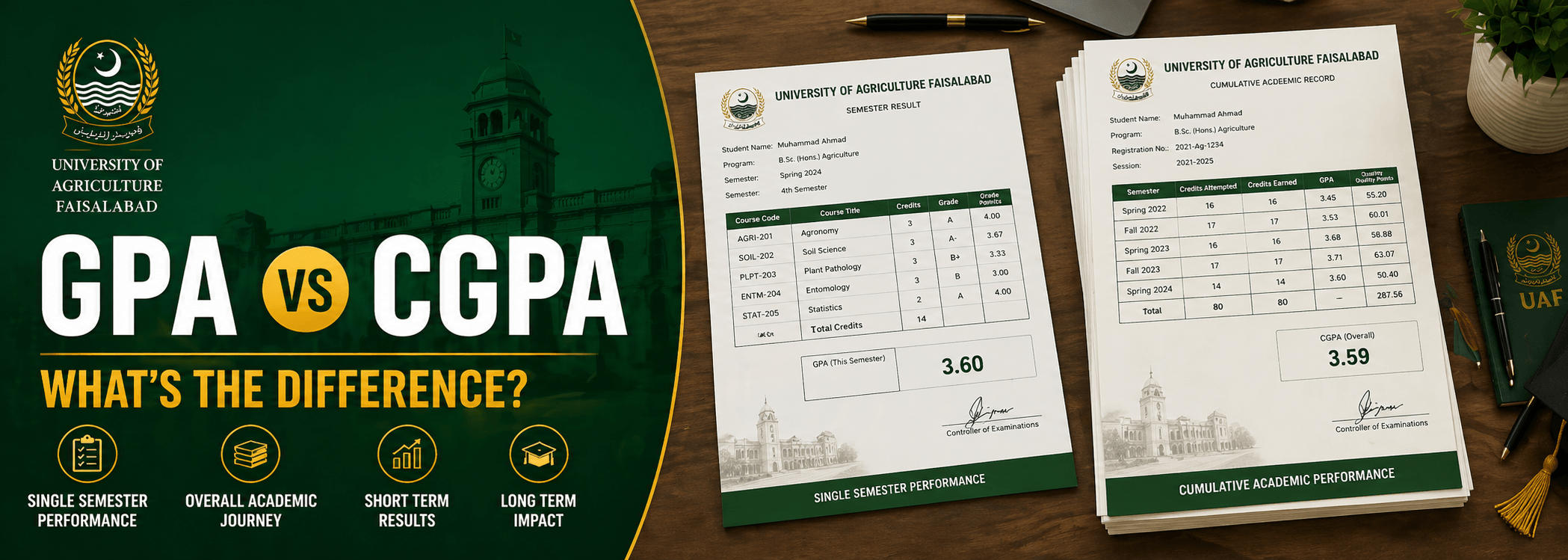
Walk into any UAF exam hall and ask ten students what their GPA is. Five will give you their most recent semester GPA. Three will give their CGPA. Two will have no idea which one they're quoting. This confusion is extremely common — and it can have real consequences when filling out scholarship applications, job forms, or graduate school applications.
This article provides a complete, clear explanation of the difference between GPA (Semester GPA or SGPA) and CGPA (Cumulative GPA) at UAF: how each is calculated, when each is used, how they relate to each other, and most importantly — which one actually matters for your academic future.
The Core Difference in One Sentence
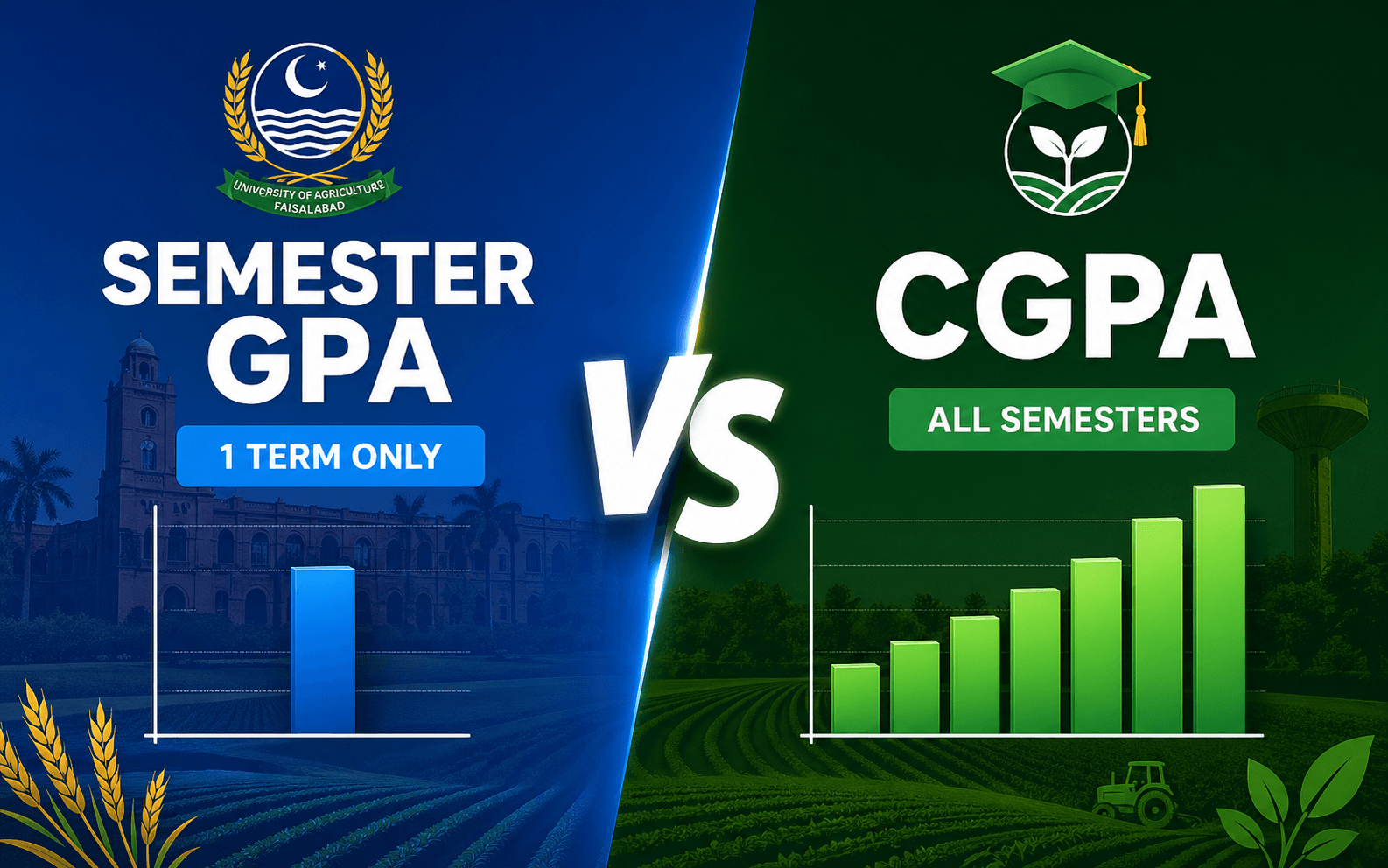
GPA/SGPA = your performance in one semester only, and it resets every term.
CGPA = your performance across all semesters combined, and it never resets.
Both use the same underlying formula — Total Quality Points ÷ Total Credit Hours — but the GPA applies it to just one semester's data, while the CGPA applies it to the running total of all your semesters since you started at UAF.
How Semester GPA (SGPA) is Calculated
Semester GPA is calculated fresh at the end of every semester. Only the courses completed in that specific semester are included. Here is a worked example for a student's third semester:
| Course | Credit Hours | Grade | GPA Points | Quality Points |
|---|---|---|---|---|
| Soil Science | 3 | A– | 3.7 | 11.1 |
| Plant Physiology | 3 | B+ | 3.3 | 9.9 |
| Agricultural Economics | 3 | A | 4.0 | 12.0 |
| Entomology | 3 | B | 3.0 | 9.0 |
| Entomology Lab | 1 | A+ | 4.0 | 4.0 |
| Islamic Studies | 2 | P | Excluded | — |
| Total | 13 (excl. P) | — | — | 46.0 |
Spring 2023 Semester GPA = 46.0 ÷ 13 = 3.538
This 3.538 is the GPA for Spring 2023 only. The moment Fall 2023 begins, this semester's GPA becomes a historical data point and a new semester GPA starts building from zero.
How Cumulative GPA (CGPA) is Calculated
CGPA is calculated by combining quality points and credit hours from ALL semesters the student has completed. Let's extend the example to show how CGPA is built over time:
| Semester | Sem Credits | Sem QP | Sem GPA | Cumulative Credits | Cumulative QP | CGPA |
|---|---|---|---|---|---|---|
| Sem 1 (Fall 2021) | 14 | 42.5 | 3.036 | 14 | 42.5 | 3.036 |
| Sem 2 (Spring 2022) | 15 | 49.5 | 3.300 | 29 | 92.0 | 3.172 |
| Sem 3 (Fall 2022) | 13 | 46.0 | 3.538 | 42 | 138.0 | 3.286 |
| Sem 4 (Spring 2023) | 16 | 56.0 | 3.500 | 58 | 194.0 | 3.345 |
Notice how the CGPA (3.345) is different from any individual semester GPA. It is the weighted average of ALL quality points accumulated divided by ALL credit hours attempted. A strong semester 3 (GPA 3.538) pulled the CGPA up slightly, while the weaker semester 1 (3.036) continues to weigh it down.
Key Differences: A Complete Comparison
| Feature | Semester GPA (SGPA) | Cumulative GPA (CGPA) |
|---|---|---|
| Time Scope | One semester only | All semesters combined |
| Resets? | Yes — starts fresh every term | No — accumulates forever |
| Volatility | Can swing dramatically (1.5 to 4.0) | Changes slowly, especially with more credits |
| Used For | Dean's List, semester progress | Graduation, scholarships, jobs, grad school |
| Impact of one bad semester | Entire GPA for that term is affected | Diluted by all previous semesters |
| Impact of one great semester | That term's GPA is great | Small improvement in cumulative average |
| Minimum at UAF | Typically 2.0/semester (may vary) | 2.0 minimum to avoid probation |
| On official transcript | Shown per semester | Single cumulative figure at end |
| For scholarships | Rarely used | Primary criterion for most scholarships |
Why CGPA Is More Important Than Semester GPA
For almost every purpose that matters beyond the immediate semester, your CGPA is the number that counts. Here's a breakdown of when each metric is used:
Scholarships — CGPA Always
Every major scholarship available to UAF students — HEC, Fulbright, DAAD, Commonwealth, Prime Minister's Laptop Scheme, and UAF's own merit scholarships — uses CGPA as the primary academic criterion. When a scholarship advertises a "minimum 3.0 GPA requirement," they mean your cumulative CGPA. A spectacular last semester GPA of 3.9 will not help you if your CGPA is 2.4.
Graduate School Admissions — CGPA Always
Whether you're applying to an MS program at NUST, a PhD at a European university, or a Master's program in the United States, admissions committees look at your cumulative CGPA. They typically ask for "CGPA on a 4.0 scale" or "overall GPA," both of which refer to the cumulative figure. Some programs may also look at your last two years (upper-division GPA), but this is also a cumulative figure for those semesters.
Employment — CGPA Usually
Government agencies (PARC, NARC, Ministry of Food Security, etc.), development organisations, and competitive private sector employers in Pakistan typically request CGPA on application forms. When a job advertisement says "First Class with CGPA 3.0 or above," they mean cumulative. Only some progressive employers may consider recent semester performance when evaluating career changers or graduates with improving trajectories.
Dean's List — Semester GPA
The Dean's List is one of the few formal recognitions that uses semester GPA. To appear on the Dean's List at UAF, you typically need a semester GPA of 3.5 or higher with a full credit load and no F grades in that term. You can make the Dean's List in one semester even if your overall CGPA is below 3.5 — and conversely, you cannot make the Dean's List based on past semesters.
Academic Probation — CGPA (Usually)
While some universities place students on probation based on a single semester's performance, UAF's academic probation is primarily triggered by cumulative CGPA falling below 2.0. One difficult semester with a 1.5 GPA may not immediately trigger probation if your cumulative average is still above 2.0 — but it will move your CGPA dangerously close.
Key Insight: When anyone asks for your "GPA" in a formal context — scholarship application, job form, graduate school application — they almost always mean your CGPA. Unless the form specifically says "most recent semester GPA," always provide your cumulative GPA. Providing semester GPA when CGPA is requested is a misrepresentation, even if unintentional.
The Stability Effect: Why CGPA Becomes Harder to Change Over Time
One of the most important mathematical properties of CGPA is that it becomes increasingly stable as you accumulate more credit hours. This stability cuts both ways — it protects a good CGPA from one bad semester, but it also makes recovery from early poor performance progressively more difficult.
The numbers tell a sobering story. If you have a 2.4 CGPA after 30 credits (roughly end of Year 1), you have 100 credits remaining and need a 3.18 average — very achievable with consistent effort. If you reach the same 2.4 CGPA after 110 credits (final semester), with only 20 credits remaining, it is mathematically impossible to reach 3.0.
The lesson is simple and critical: start improving your CGPA as early as possible. Every semester you delay makes recovery harder and the required improvement more extreme.
Can a High Semester GPA Recover a Low CGPA?
Yes — but it requires sustained high performance and takes time. Let's look at realistic recovery scenarios:
| Current CGPA | Credits Completed | Credits Remaining | GPA Needed Per Remaining Credit to Reach 3.0 | Feasibility |
|---|---|---|---|---|
| 2.8 | 40 | 90 | 3.09 | ✓ Achievable with focus |
| 2.5 | 40 | 90 | 3.22 | ⚡ Requires consistent effort |
| 2.2 | 40 | 90 | 3.44 | ⚡ Difficult but possible |
| 2.8 | 70 | 60 | 3.23 | ⚡ Requires A-heavy semesters |
| 2.5 | 70 | 60 | 3.75 | ✗ Very difficult |
| 2.2 | 70 | 60 | 4.26 | ✗ Mathematically impossible |
Use improvement exams strategically to boost quality points without needing new credit hours. Improving a past course from C to A adds quality points without affecting the credit hour denominator of future calculations — making it one of the most efficient CGPA recovery tools available.
A Real Example: The "Good Semester Trap"
Many students fall into what we call the "Good Semester Trap" — they have one outstanding semester (say, 3.8 GPA) and believe their academic problems are solved. In reality, one great semester has a limited effect on a multi-year CGPA.
Example: Student has a 2.6 CGPA after 60 credits. In their next semester (15 credits), they earn a 3.8 GPA.
New quality points: 15 × 3.8 = 57.0
Old quality points: 60 × 2.6 = 156.0
New total: (156 + 57) ÷ (60 + 15) = 213 ÷ 75 = 2.84 CGPA
One brilliant semester moved the CGPA from 2.6 to only 2.84 — still below First Class. Recovery requires sustained effort across many semesters, not one exceptional performance.
Check Both Your GPA and CGPA on UAFCalc
UAFCalc.site shows your CGPA plus semester-by-semester GPA breakdown so you can track your academic trajectory accurately.
Open CGPA CalculatorCommon Misconceptions About GPA vs CGPA
Misconception 1: "I have a 3.8 GPA" (when they mean last semester's GPA)
This is harmless in casual conversation but dangerous on formal applications. Always be precise about which figure you're quoting. If someone asks "what's your GPA?" in a formal context, they want your CGPA.
Misconception 2: "My GPA was good last semester, so my CGPA is fine"
Not necessarily. If your CGPA was 2.4 before a strong semester, it may still be below 3.0 after. Check using UAFCalc.site rather than assuming.
Misconception 3: "I just need one great semester to fix my CGPA"
As shown mathematically above, this is rarely true. One semester can start a recovery trajectory, but sustained improvement over multiple semesters is what changes CGPA significantly.
Misconception 4: "My CGPA will improve automatically as I take more courses"
Only if your new semester GPA is higher than your current CGPA. If you're earning the same GPA every semester as your current CGPA, the CGPA will stay flat. To improve CGPA, your semester GPA must be consistently higher than your current cumulative average.
Practical Tips: Managing Both Metrics
- Track your CGPA after every semester using UAFCalc.site so you know exactly where you stand and whether you're improving
- Set semester GPA targets that are higher than your current CGPA — this is the only way to pull the cumulative average up
- Use improvement exams to boost quality points from old semesters — this improves CGPA without needing new credit hours
- Understand the Dean's List separately — you can earn Dean's List recognition in a semester where your CGPA is below 3.5, because they're different metrics
- Never quote semester GPA as CGPA on applications — this is a misrepresentation even if unintentional
Conclusion
The difference between GPA and CGPA is fundamental to understanding your academic position at UAF. Semester GPA tells you how you performed in one specific term and resets every semester. CGPA tells the complete story of your academic journey and is what the world uses to evaluate you.
For scholarships, graduate school, and most employment, your CGPA is the figure that matters. Start improving it early — the stability effect means that early high performance protects you from future difficult semesters, while early poor performance requires years of sustained excellence to overcome.
Use UAFCalc.site to check your current CGPA and see your semester-by-semester GPA history. Then read our guide on 10 proven ways to improve your CGPA to start making moves this semester.