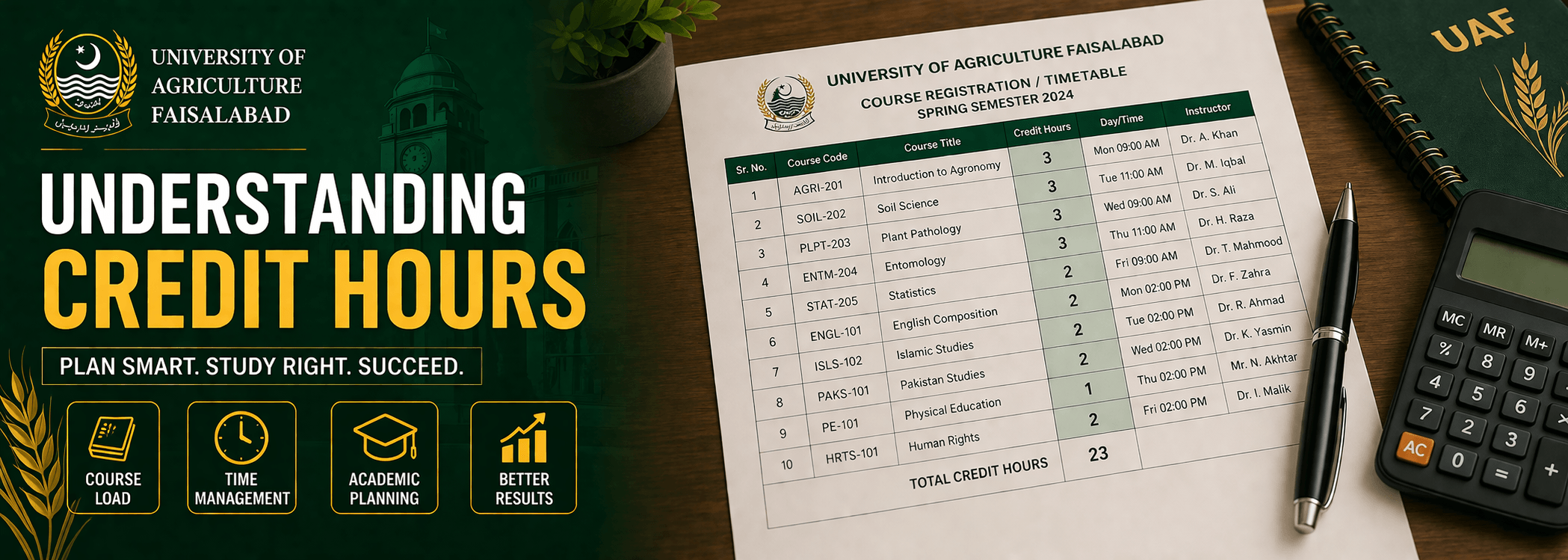
Credit hours are the invisible architecture of your CGPA. Every time you enrol in a course, you are not just signing up for learning — you are assigning a weight to that course's grade in your cumulative average. A 4-credit course carries four times the GPA significance of a 1-credit lab. Yet most UAF students spend roughly equal time worrying about all their courses, regardless of credit weight.
Understanding credit hours is not just academic trivia — it is the strategic foundation for every CGPA-improvement decision you make: which courses to prioritise each week, which improvement exams are worth attempting, how to plan your semester load, and why certain subjects matter far more than others for your academic future.
What Is a Credit Hour?
A credit hour (also called a credit unit or credit point) is the basic unit of academic measurement at UAF. It represents the learning load associated with a course over one semester. The standard definition in Pakistani higher education, following HEC guidelines, is:
Definition
1 Credit Hour = 1 hour of formal instruction per week for one semester (approximately 16–18 weeks)
For laboratory/practical courses: 1 credit hour typically requires 2–3 hours of lab work per week
So a 3-credit course meets for approximately 3 hours per week over the semester (48–54 total contact hours), while a 1-credit lab meets for 1–2 hours but requires 2–3 hours of actual lab work per session.
Common Credit Hour Values at UAF
At UAF, courses fall into several credit-hour categories depending on their nature:
| Credit Hours | Course Type | Examples at UAF | CGPA Weight |
|---|---|---|---|
| 1 credit | Laboratory practicals, physical education, short skill courses | Biology Lab, Chemistry Lab, PE, Field Practicum | Low (1× weight) |
| 2 credits | Minor theory courses, language courses, applied skills | English (some programs), Islamiyat*, Pakistan Studies* | Medium (2× weight) |
| 3 credits | Standard theory courses — the most common type at UAF | Agronomy, Soil Science, Plant Physiology, Biochemistry, Statistics | High (3× weight) |
| 4 credits | Heavy courses combining significant theory with lab/practical components | General Chemistry (3+1), Organic Chemistry, Advanced Agronomy | Highest (4× weight) |
*Islamiyat and Pakistan Studies are often P/F graded and excluded from CGPA calculation — check your program's course outline
How Credit Hours Create the Weighting Effect in CGPA
The CGPA formula is a weighted average where credit hours are the weights:
CGPA = Σ(GPA Points × Credit Hours) ÷ Σ(Credit Hours)
This means that a 4-credit course contributes 4 "votes" to your CGPA calculation while a 1-credit course contributes only 1 "vote." Here is a concrete illustration with a student who takes 5 courses in one semester:
| Course | Credit Hours | Grade | GPA Points | Quality Points (QP) | % of Semester GPA |
|---|---|---|---|---|---|
| Advanced Soil Science | 4 | A– (3.7) | 3.7 | 14.8 | 36.4% |
| Plant Breeding | 3 | B+ (3.3) | 3.3 | 9.9 | 27.3% |
| Agricultural Economics | 3 | B (3.0) | 3.0 | 9.0 | 27.3% |
| Research Methods Lab | 1 | A (4.0) | 4.0 | 4.0 | 9.1% |
| Totals | 11 | — | — | 37.7 | 100% |
Semester GPA = 37.7 ÷ 11 = 3.427
Notice that the 4-credit Advanced Soil Science course contributes 36.4% of the semester GPA calculation — more than three times what the 1-credit lab contributes (9.1%). If this student had earned an A (4.0) instead of A– (3.7) in Soil Science, their GPA would rise to (37.7 + 1.2) ÷ 11 = 3.536 — a significant jump from a single grade improvement in one high-credit course.

The Stability Effect: Why Early Credits Matter Most
Another critical property of credit hours is that early credits have a permanent, compounding effect on your CGPA. Because CGPA is a running weighted average, the relative weight of each credit hour decreases as you accumulate more total credits.
Here is what this means practically:
| When You Take a 3-Credit Course | Its Share of Total Credits | CGPA Impact per QP Change |
|---|---|---|
| Semester 1 (15 total credits) | 3/15 = 20.0% | Very large |
| Semester 3 (45 total credits) | 3/45 = 6.7% | Significant |
| Semester 5 (75 total credits) | 3/75 = 4.0% | Moderate |
| Semester 7 (105 total credits) | 3/105 = 2.9% | Small |
| Final semester (130 total credits) | 3/130 = 2.3% | Minimal |
This table reveals a sobering truth: a 3-credit course in your first semester has nearly 9× more CGPA influence than the same 3-credit course in your final semester. Grades you earn in Years 1 and 2 are mathematically the most valuable for long-term CGPA health — and the most damaging if they go wrong.
How Many Credit Hours Does UAF Require to Graduate?
Most UAF undergraduate programs require between 130 and 145 credit hours for graduation. The exact number depends on your specific program and year of admission. Here are typical totals for common UAF programs:
| Program | Typical Total Credits | Duration |
|---|---|---|
| BS Agronomy | 133–138 | 4 years (8 semesters) |
| BS Plant Breeding & Genetics | 132–136 | 4 years |
| BS Soil Science | 130–135 | 4 years |
| BS Food Science & Technology | 133–140 | 4 years |
| BS Computer Science | 130–136 | 4 years |
| BS Animal Science | 132–138 | 4 years |
| BS Agricultural Engineering | 138–145 | 4 years |
| MS/MPhil (various) | 30–36 | 1.5–2 years |
These programs are structured across 8 semesters, typically with 15–18 credit hours per semester. The final semester often includes a research project or thesis that carries significant credit weight.
Credit Hours and Semester Load Planning
UAF's academic regulations typically allow students to register for:
- Minimum: 9 credit hours per semester (below this, you may not be considered a full-time student)
- Standard: 15–17 credit hours (typical load)
- Maximum: 18 credit hours (requires academic dean approval in some programs)
- Exceptional cases: Students with CGPA above 3.5 may be permitted to take up to 21 credit hours in some programs
The Strategic Case for 15 Credits Over 18
Many students assume that taking the maximum 18 credits is always better — more credits completed faster. But the math often tells a different story. Taking 18 credits while spread thin across 6 courses can result in 3.0 average performance across all courses. Taking 15 credits with focused attention on 5 courses may produce 3.6–3.8 average performance.
Comparing quality points: 18 × 3.0 = 54 QP vs 15 × 3.7 = 55.5 QP. The focused 15-credit semester generates more quality points despite fewer credits, while also reducing the risk of an F grade that could catastrophically damage your CGPA.
The 3+1 System: Theory Plus Lab Credits
Many UAF science and engineering courses follow a "3+1" credit structure: 3 theory credit hours plus 1 practical/laboratory credit hour, typically listed as a single 4-credit course in your programme, or sometimes as two separate courses (3-credit theory + 1-credit lab) with linked registration.
Understanding the implications of this structure:
- Failing the lab (1cr) while passing the theory (3cr): You fail the 1-credit component. This typically means failing the whole course in integrated 4-credit designs. In separate 3+1 designs, you may be able to retake only the lab.
- Grade averaging: In some integrated 4-credit courses, theory and practical marks are combined into a single grade. In others, they are graded separately and must both be passed independently.
- Time investment: A 3+1 course demands both regular class attendance (3hr/week) and laboratory sessions (2–3hr/week). Budget your time accordingly.
Credit Hours in Improvement Exams: The Strategic Mathematics
When selecting which courses to target for improvement exams, credit hours determine the mathematical return on your investment of time and effort. Here is a complete worked example:
A student has completed 80 credits with a CGPA of 2.75. They are considering improvement exams for three possible courses:
| Course | Credit Hours | Current Grade | Target Grade | QP Gained | New CGPA (approx.) |
|---|---|---|---|---|---|
| Agronomy Fundamentals | 4 | C+ (2.3) | A (4.0) | +6.8 | 2.835 (+0.085) |
| Plant Science Theory | 3 | B– (2.7) | A (4.0) | +3.9 | 2.799 (+0.049) |
| Biology Lab Practical | 1 | B (3.0) | A (4.0) | +1.0 | 2.762 (+0.012) |
The 4-credit Agronomy improvement gives 7× more CGPA boost than the 1-credit lab improvement. If this student can only appear in one improvement exam, the choice is mathematically obvious: the 4-credit C+ course.
Credit Hour Priority Rule: For improvement exams, always calculate "Quality Points to be Gained = Credit Hours × (Target GPA Points − Current GPA Points)" for each candidate course. Rank them by this number and start at the top. This single formula will guide your improvement exam strategy better than any other approach.
How P/F Courses Interact with Credit Hours
Pass/Fail courses present a special case in credit hour calculations. Although they often carry 1–2 credit hours, they are completely excluded from the CGPA formula — both the credit hours and the quality points are omitted. This creates an important distinction:
- Graduation credits: P/F course credit hours DO count toward your total graduation credits requirement. You need them to graduate.
- CGPA calculation: P/F course credit hours do NOT count in the denominator of the CGPA formula. They have zero effect on your GPA average.
This means a P grade in a 2-credit Islamiyat course counts as 2 credits toward graduation but adds 0 to your CGPA calculation — it neither helps nor hurts. Students sometimes mistakenly include P/F course credits in their manual CGPA calculations, producing an artificially lower CGPA than the actual figure.
Planning Your Total Credit Hour Journey to Graduation
With 130–140 credit hours required for most UAF programs across 8 semesters, here is a realistic credit distribution strategy for maintaining a strong CGPA:
Year 1 Strategy: Lighter Load, Stronger Foundation
Because Year 1 credits carry the most CGPA weight per credit hour, it is strategically wise to take a slightly lighter load (15–16 credits) and invest maximum effort in each course. An A in every Year 1 course creates a CGPA cushion that protects you through more difficult future semesters.
Years 2–3 Strategy: Full Load
By Year 2, you have a clearer sense of your academic strengths, your credit hours carry less individual weight, and you have established study habits. This is the time to take maximum credit loads (17–18 credits) while maintaining strong performance, accumulating credits efficiently toward graduation.
Year 4 Strategy: Quality Over Quantity
In your final year, especially Semester 8 (the thesis semester), reduce your credit load to allow quality focus on your research project. A strong thesis grade (often 6–9 credit hours in some programs) can meaningfully improve your CGPA, and a poor thesis grade will hurt. Prioritise it.
Using UAFCalc.site to Analyse Your Credit Hour Distribution
When you view your results on UAFCalc.site, the system shows you for each student:
- Total credit hours attempted (included in CGPA calculation)
- Total quality points earned
- Semester-by-semester breakdown of credits and GPA
- Individual course credit hours and marks
This data lets you quickly identify which semesters and courses are most influencing your CGPA, and calculate exactly which improvement exams would be most beneficial.
See Your Credit Hour Distribution Now
UAFCalc.site shows your total credits, quality points, and full semester breakdown — all in under 0.3 seconds. Use it to plan your CGPA improvement strategy.
View My Academic StatsKey Takeaways
- Credit hours are weights: A 4-credit course contributes 4× more to your CGPA than a 1-credit lab — allocate study time proportionally.
- Early credits matter most: Year 1 and Year 2 courses have up to 9× more CGPA impact than final-year courses. Protect those grades.
- P/F courses are excluded: They count toward graduation credits but have zero effect on CGPA — neither positive nor negative.
- Improvement exam priority: Calculate (Credit Hours × Grade Point Difference) for each candidate course and target the highest number first.
- Quality beats quantity: 15 focused credits at 3.7 GPA usually generates more quality points than 18 spread-thin credits at 3.0 — with less risk.
- Know your total: Check UAFCalc.site to see your exact credit hour total, quality points, and CGPA at any point in your degree.