
Your CGPA is not a fixed number. It is a running calculation — and like any calculation, changing the inputs changes the output. Whether you are starting from a 2.0 or a 3.2, the strategies in this guide will help you move your CGPA in the right direction. These are not generic study tips copied from the internet — they are specific, mathematical approaches tailored to UAF's credit-hour weighted grading system.
Each tip below comes with a concrete explanation of why it works mathematically, not just motivationally. Understanding the mechanism helps you apply it strategically rather than hoping for the best.
First: Know Your Exact Starting Position
Before implementing any improvement strategy, you need to know exactly where you stand. This means knowing your CGPA to three decimal places, how many credit hours you have completed, how many remain, and which specific courses are dragging your average down most.
Use UAFCalc.site to fetch your current CGPA instantly. Once you have that number, you can calculate exactly what semester GPA you need for the remainder of your degree to reach any target CGPA:
Required GPA Formula
Required GPA = (Target CGPA × Total Credits − Current QP) ÷ Remaining Credits
Where Current QP = Current CGPA × Credits Completed
Example: CGPA 2.6 after 60 credits, target 3.0 by graduation at 130 credits:
Required GPA = (3.0 × 130 − 2.6 × 60) ÷ (130 − 60) = (390 − 156) ÷ 70 = 234 ÷ 70 = 3.343
This student needs a 3.343 average GPA for every remaining credit to hit 3.0 at graduation. Knowing this number gives you a concrete target for each semester.
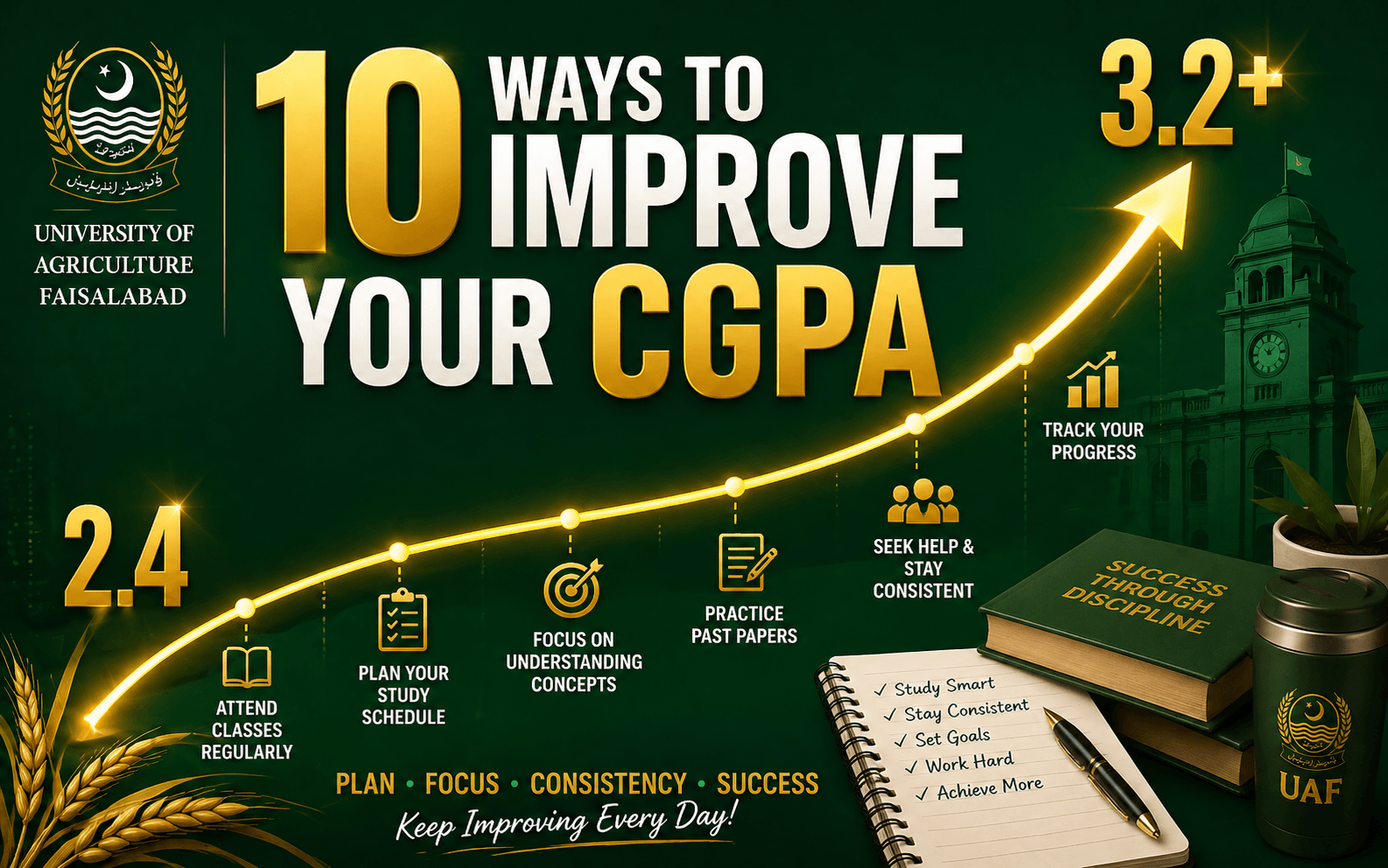
Tip 1: Use Improvement Exams Strategically (Highest ROI)
Improvement exams are the single most powerful CGPA-boosting tool available at UAF, and most students severely underuse them. Here is why they have such high return on investment:
When you improve a past course's grade, you add quality points to the numerator of your CGPA formula without adding any credit hours to the denominator (they're already counted). This means every quality point gained through an improvement exam is "worth more" than quality points from a new course.
The improvement exam priority formula: Quality Points Gained = Credit Hours × (New GPA Points − Old GPA Points)
| Course | Credit Hours | Old Grade | Target Grade | QP Gained | Priority |
|---|---|---|---|---|---|
| Agronomy (heavy) | 4 | C+ (2.3) | A (4.0) | 4×1.7 = 6.8 | 🥇 Top Priority |
| Soil Science | 3 | C (2.0) | A (4.0) | 3×2.0 = 6.0 | 🥈 High |
| Plant Biology | 3 | B (3.0) | A (4.0) | 3×1.0 = 3.0 | Medium |
| English | 3 | B+ (3.3) | A (4.0) | 3×0.7 = 2.1 | Low-Medium |
| Lab Practical | 1 | B (3.0) | A (4.0) | 1×1.0 = 1.0 | Low Priority |
Always target your lowest-grade, highest-credit-hour courses first. A 4-credit C+ improved to A is worth nearly 7 extra quality points — the equivalent of scoring A instead of C in two 3-credit courses across future semesters.
Action this week: Open UAFCalc.site, view your course breakdown, and identify your three lowest-grade, highest-credit courses. These are your improvement exam targets. Check UAF's academic calendar for the next improvement exam registration window.
Tip 2: Understand Credit Hour Weighting and Plan Accordingly
Not all courses affect your CGPA equally. A 4-credit course has four times the CGPA impact of a 1-credit lab. Most UAF students study for all courses with roughly equal effort, which is a systematic mistake.
Practical application: Create a priority list of your courses each semester ranked by credit hours. Allocate study time proportionally — approximately 40% more time to 3-4 credit courses than to 1-2 credit courses. When forced to choose between studying for a 3-credit exam or a 1-credit lab practical, always prioritise the 3-credit exam.
Tip 3: Never Miss a Supplementary Exam for a Failed Course
An F grade (0.0 GPA points) is among the most damaging academic events for your CGPA. The credit hours of an F course count in the denominator but contribute 0 to the numerator. A supplementary exam can convert an F to at least a D (0.7 GPA points) — and that 0.7 improvement per credit hour makes an enormous difference.
Impact of converting F to D in a 3-credit course after 60 credits:
- Before: 60cr, 180 QP → CGPA = 3.000
- After supplementary (D grade): 60cr, 180 + (3×0.7) = 182.1 QP → CGPA = 3.035
That is a 0.035 CGPA improvement from passing a supplementary exam. If instead you convert it to a C (2.0): CGPA jumps from 3.000 to 3.100. An A in the supplementary pushes it to 3.200.
There is literally no downside to attempting a supplementary or improvement exam. Your grade can only stay the same or improve — UAF keeps the better grade regardless of how you perform.
Tip 4: Protect First-Year Grades Fiercely
First-year grades have a disproportionately large impact on your CGPA for a simple mathematical reason: when you have 30 credits completed, each credit hour represents 3.3% of your CGPA calculation. By the time you have 120 credits, each credit represents just 0.83%.
Poor first-year performance creates a mathematical anchor that drags your CGPA down for the rest of your degree. Students who earn 2.5 averages in Year 1 often find themselves unable to recover to 3.0 even with excellent performance in later years.
Conversely, strong first-year performance creates a protective cushion. A student who earns a 3.6 average in Year 1 can afford occasional lower semesters (3.0–3.2) in later years while maintaining a 3.3+ CGPA.
For First-Year Students: Treat your first two semesters as the most important of your entire degree. The grades you earn now will influence your CGPA more than grades you earn in your final year. Every A you earn in Year 1 is worth approximately 4× as much long-term protection as an A in Year 4.
Tip 5: Attend Every Lecture — Especially in High-Credit Courses
At UAF, internal assessment (sessional marks, quizzes, assignments, attendance) contributes 15–25% of your final grade. Missing lectures means missing quizzes, class participation, and sometimes the informal revision that clarifies exam-relevant content.
The mathematics of attendance are unforgiving. If sessional marks are 15 marks out of 100, missing even 5 marks from poor attendance drops your final percentage by 5 points — which could be the difference between A– (80%) and B+ (79%), a gap of 0.4 GPA points. In a 3-credit course, that 0.4 difference costs you 1.2 quality points per semester and 4–8 quality points across your degree.
The rule is simple: attend every lecture of every 3-credit and 4-credit course. Missing labs and 1-credit courses is costly too, but missing heavy theory courses is academically catastrophic.
Tip 6: Master Past Papers Before Every Exam
UAF exams are heavily pattern-based. Most departments have a consistent style of questions — the same topic areas appear with similar phrasing year after year. Students who systematically work through 3–5 years of past papers before each exam have a significant advantage.
The approach: obtain past papers from seniors or your department, solve them under timed exam conditions (without notes), then compare your answers with model solutions. Identify which topics appear in every exam — these are high-priority areas that guarantee questions every year.
Studies of academic performance consistently show that exam practice (retrieving information under test conditions) is more effective for grade improvement than re-reading notes or making summaries. Practice exam conditions, not comfortable study conditions.
Past paper practice and active recall outperform passive re-reading by a large margin
Tip 7: Build a Study Group with Clear Academic Standards
Study groups are powerful when structured properly and counterproductive when they become social sessions. The difference is in the structure:
Effective study group rules:
- Maximum 4–5 members — larger groups fragment attention
- Each session has a specific agenda: "Today we solve the last 3 years of Soil Science past papers"
- Members take turns explaining topics to each other — this is the highest-impact study method
- Sessions are time-limited: 90 minutes maximum
- Phones are put away during the session
- Members who repeatedly come unprepared are replaced
The act of explaining a concept to another person requires you to retrieve it from memory and structure it coherently — both activities that dramatically strengthen long-term retention. Students who regularly teach each other course content consistently outperform solo studiers on exams.
Tip 8: Communicate with Professors Before Grades Are Finalised
Many UAF students avoid faculty contact, not realising that professors have discretion in borderline grade situations. A student who earned 79.4% (technically B+, just 0.6 short of A–) and has been an engaged, present, and participatory student is in a very different position from a ghost who only showed up for exams.
Professors notice students who ask questions, attend office hours, and show genuine interest. If you are 1–2 marks below a grade boundary, a respectful conversation with the professor about your performance, demonstrating your understanding and commitment, is always worth having. The worst outcome is no change. The best outcome is a mark or two of discretion that moves you into the higher grade band.
Importantly, this only works if you have built a legitimate academic relationship throughout the semester — not if you show up the day after results asking for marks you didn't earn.
Tip 9: Manage Your Course Load Strategically Each Semester
UAF typically allows 15–18 credit hours per semester. Taking the maximum 18 credits while managing part-time work, personal responsibilities, or a particularly demanding batch of courses can result in mediocre performance across all courses — which harms your CGPA more than taking 15 credits and earning excellent grades in each.
A strategic course load analysis:
| Load Option | Scenario | Likely GPA | Quality Points |
|---|---|---|---|
| 18 credits (max) | Spread thin across 6 courses | ~3.0 avg | 54.0 QP |
| 15 credits (strategic) | Focused on 5 courses | ~3.5 avg | 52.5 QP |
| 15 credits (excellent) | Full focus on 5 courses | ~3.8 avg | 57.0 QP |
In this example, taking 15 focused credits and earning a 3.8 GPA generates more quality points than taking 18 spread-thin credits with a 3.0 average — and you avoid the risk of a low grade dragging your CGPA down. Quality beats quantity every time.
Tip 10: Track Your CGPA After Every Semester and Adjust
You cannot improve what you don't measure. After every semester's results are published, use UAFCalc.site to:
- Calculate your updated CGPA (takes under 0.3 seconds)
- Identify which courses in the completed semester had the lowest grade-to-credit-hour ratio
- Add those courses to your improvement exam consideration list
- Recalculate the GPA you need per remaining credit to reach your target CGPA
- Adjust your study intensity and course load for the next semester accordingly
Students who track their CGPA actively and adjust their strategy each semester consistently outperform those who only check their results passively. The data makes the right decisions obvious — and UAFCalc.site makes getting that data take less than a second.
Start Tracking Your CGPA Today
Enter your AG number and see your current CGPA, which courses are dragging you down, and your full semester history — all free, all instant.
Check My CGPA NowBonus: The Compound Effect of Consistent Improvement
Here's the most motivating mathematical truth about CGPA improvement: consistent moderate improvement compounds significantly over time. You do not need heroic 4.0 semesters to dramatically improve your CGPA. Consistent 3.5+ semesters sustained over 2–3 years will move a 2.4 CGPA well above 3.0.
| Starting CGPA (60cr) | Strategy | CGPA after 70 more credits |
|---|---|---|
| 2.4 | Continue same performance (2.4 GPA/sem) | 2.400 — no change |
| Consistent 3.2 GPA each semester | 2.707 — significant improvement | |
| Consistent 3.6 GPA + improvement exams | 3.1+ — First Class territory |
The message is clear: it is not about being perfect; it is about being consistently better than your current average, sustained over time.
Your CGPA Improvement Action Plan
Here is your immediate action plan based on this guide:
- Today: Check your current CGPA on UAFCalc.site. Note the exact number, total credits, and identify your three lowest-grade highest-credit courses.
- This week: Calculate your required semester GPA using the formula above. Register for improvement exams if the window is open.
- This semester: Prioritise 3-4 credit courses in your study time. Attend every lecture. Build a proper study group. Solve past papers starting Week 6 before finals.
- Each semester: Check CGPA after results, adjust strategy, identify improvement exam targets, recalculate required future GPA.
CGPA improvement is a marathon, not a sprint. Consistent execution of the right strategies produces results that feel dramatic over 2–3 years, even though each individual step feels modest. Start today — the mathematics of recovery only get harder with each semester you delay.