
Understanding UAF's grading system is the foundation of managing your academic career at the University of Agriculture Faisalabad. Every assignment, quiz, mid-term, and final exam feeds into a letter grade, and every letter grade translates to a specific number of GPA points. These GPA points, weighted by credit hours, determine your CGPA — and ultimately your degree class, scholarship eligibility, and future opportunities.
This comprehensive guide covers every aspect of UAF's grading system: the complete grade scale with percentage ranges, the GPA point value for every grade, how grades are assigned, what each grade means for your academic standing, and the special rules for Pass/Fail courses, withdrawal, and incomplete grades.
The Foundation: How UAF Grades Are Determined
At UAF, your final grade in most courses is calculated from multiple components weighted differently depending on the course and faculty. The typical assessment breakdown at UAF is:
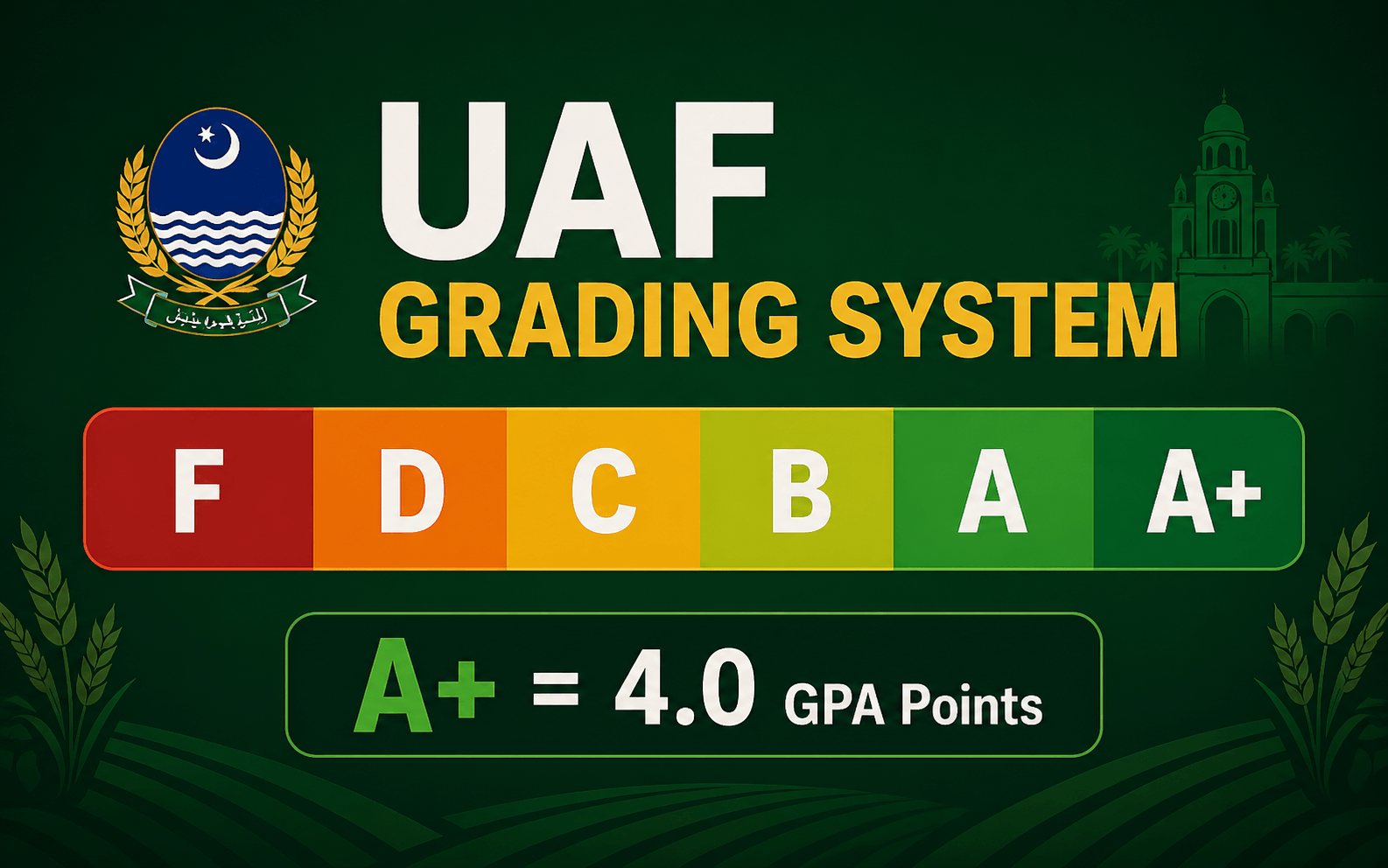
An important nuance: A+ and A both give exactly 4.0 GPA points. This means there is no CGPA benefit to scoring above 85% — both 86% and 99% give you 4.0 points for that course. For strategic time management, once you are confident of an A, additional study time in that course produces zero additional CGPA benefit and is better invested elsewhere.
The B Band (65–79%): Solid Performance
B-band grades (B–, B, B+) represent solid, above-average academic performance. A CGPA built primarily on B grades will typically fall in the 2.7–3.3 range, which qualifies for First Class. Many competitive employers and graduate programs accept First Class qualification without distinction.
The C Band (50–64%): Minimum Acceptability
C-band grades (C–, C, C+) represent passing performance but below the level needed for First Class qualification. Students with predominantly C grades will have a CGPA between 1.7 and 2.3, which places them in Second Class territory. If your current CGPA is in this zone, using improvement exams to convert C grades to B or A grades is the most effective CGPA recovery strategy.
The D Band (40–49%): Danger Zone
D-band grades are technically passing but severely damage your CGPA. A D (1.0 GPA points) in a 3-credit course gives only 3.0 quality points versus 12.0 for an A. Students earning D grades consistently will struggle to stay above the 2.0 CGPA threshold and are at risk of academic probation. If you receive a D, seriously consider appearing in an improvement exam.
F Grade (Below 40%): Failure and Recovery
An F grade means you have failed the course and earned 0 GPA points for those credit hours. Critically, the credit hours of an F course are still counted in the denominator of your CGPA calculation — you get 0 quality points but the credit hours count against you. This double penalty makes F grades extremely damaging to CGPA.
Pass/Fail (P/F) Courses at UAF
Several courses at UAF are assessed on a Pass/Fail basis rather than the letter grade system. Understanding how these work is important for CGPA calculation and course planning.
Which Courses are Typically P/F at UAF?
- Islamic Studies / Islamiyat — Compulsory for Muslim students in most UAF programs
- Pakistan Studies — In some programs and semesters
- Physical Education — Sports and fitness courses
- Library courses — Short orientation or library skills modules
- Community service modules — In some undergraduate programs
P/F Grading Rules
A P (Pass) grade is awarded when you meet the minimum passing threshold (typically 40%). P grades are completely excluded from CGPA calculation — neither the quality points (there are none) nor the credit hours are included in the formula. This means P courses cannot help or hurt your CGPA. However, you must pass them to graduate, as they are listed as program requirements.
Failing a P/F course results in an F or NP (Not Pass) grade. Depending on UAF's policy for that specific course, this may or may not count toward CGPA. Check with your department if you are at risk of failing a P/F course.
Academic Probation and Minimum CGPA Requirements
UAF requires all students to maintain a minimum CGPA to remain in good academic standing. Falling below this threshold triggers academic consequences:
First Warning (CGPA 1.5–1.99)
Students whose CGPA falls between 1.5 and 1.99 may receive a formal academic warning from their department. They are typically required to meet with their academic advisor, create an improvement plan, and may be restricted from taking certain advanced courses until their CGPA recovers above 2.0.
Academic Probation (CGPA Below 2.0)
Students with a cumulative CGPA below 2.0 are placed on academic probation. This status has several consequences:
- May not be eligible for university housing, scholarships, or student organization leadership positions
- Required to meet with academic advisor every semester
- May face restrictions on credit hour load
- Must raise CGPA above 2.0 within a specified number of semesters or face suspension
Academic Suspension
Students who remain on academic probation for multiple consecutive semesters without improvement may face academic suspension — a temporary ban from UAF enrollment. Reinstatement requires a formal appeal and may come with conditions attached.
Urgent Action Required: If your CGPA is approaching or below 2.0, act immediately. Do not wait for next semester. Contact your academic advisor, identify courses for improvement exams this semester, and use UAFCalc.site to model what CGPA you need from each remaining course to recover your standing.
The Degree Classification System at UAF
When you complete all program requirements and your CGPA is calculated across every semester, UAF assigns your official degree class. This classification appears on your degree certificate and official transcript and is the credential you present to employers and graduate schools.
First Class with Distinction (CGPA 3.70–4.00)
The highest academic achievement at UAF. Students in this category demonstrate consistently outstanding performance across all semesters. This classification opens doors to the most competitive scholarships (HEC Overseas, Fulbright, DAAD), PhD program admissions, and top-tier employment opportunities. Only approximately 5–10% of UAF graduates achieve this classification.
First Class (CGPA 3.00–3.69)
Represents strong, above-average academic performance. First Class graduates are competitive for most graduate programs in Pakistan and internationally, qualify for many scholarships, and are well-positioned in the job market. Approximately 30–40% of UAF graduates earn First Class.
Second Class Upper Division (CGPA 2.50–2.99)
Represents satisfactory academic performance. Second Class Upper graduates are eligible for most Pakistani graduate programs, though international MS and PhD programs often require First Class or better. Employment opportunities are generally good in most agricultural and related fields.
Second Class Lower Division (CGPA 2.00–2.49)
Represents minimum acceptable academic performance. Graduates in this category have fewer options for graduate study and may face challenges in competitive employment sectors. Many public sector positions in Pakistan specifically require First Class standing.
The Gold Medal and Vice Chancellor's Award
UAF awards the prestigious Vice Chancellor's Gold Medal to the student with the highest CGPA in each graduating batch of each program. To be eligible for the Gold Medal, you typically need:
- CGPA above 3.90 (varies by year and competition)
- No F grades in any semester
- No academic misconduct or disciplinary action
- Completion of all courses within the standard program duration
- No repeated courses (improvement exams may disqualify in some programs — verify with your department)
The Improvement Exam System
One of the most important aspects of UAF's grading system is the opportunity for grade improvement. UAF conducts supplementary and improvement exams that allow students to raise their grades in already-completed courses.
Types of Improvement Opportunities
| Type | Eligibility | Timing | CGPA Effect |
|---|---|---|---|
| Supplementary Exam | Students who failed (F grade) | Shortly after regular results | Replaces F if passed (better grade counts) |
| Improvement Exam | Students who passed but want better grade | Same period as supplementary | Better of two grades counts; cannot go lower |
| Course Repeat | Both failed and passed courses | Next available semester | Better grade counts; original stays on transcript |
How to Use the Grade System Strategically
Now that you understand the full UAF grade system, here are strategic insights for maximising your CGPA:
Strategy 1: Protect Your A-band in High-Credit Courses
Since credit hours amplify the effect of each grade, your priority should be earning A or A– grades in 3-credit and 4-credit courses. Even dropping from A to A– (4.0 to 3.7) in a 4-credit course costs you 1.2 quality points, which could drop your overall CGPA by 0.02–0.04 points depending on your total credits.
Strategy 2: Never Let a C Become an F
The difference between a C (2.0 GPA points) and an F (0.0) in a 3-credit course is 6.0 quality points. To recover from one F, you need to earn approximately two extra A grades (instead of Bs) in other 3-credit courses. Always attend supplementary exams if you're at risk of failing.
Strategy 3: Use the A+/A Equivalence to Your Advantage
Since A and A+ both give 4.0 GPA points, once you have secured an A in a course, spending additional hours pushing for A+ is pure time wasted for CGPA purposes. Redirect that time to another course where you might be hovering between B+ and A.
Strategy 4: Target Your Improvement Exam Strategically
When deciding which courses to improve, use this formula: Quality Points to be Gained = Credit Hours × (New GPA Points – Old GPA Points). Maximise this number. A 4-credit C+ (2.3) improved to A (4.0) gives 4 × 1.7 = 6.8 quality points. A 1-credit B (3.0) improved to A (4.0) gives 1 × 1.0 = 1.0 quality points. The 4-credit improvement is 6.8× more valuable.
See How Your Grades Affect Your CGPA
Use UAFCalc.site to instantly view your current grades, calculate your CGPA, and identify which courses have the most room for improvement.
Check My CGPA NowComparing UAF's Grading System to Other Pakistani Universities
UAF uses the standard 4.0-scale GPA system common across most public universities in Pakistan, but there are minor differences between institutions worth knowing if you're considering inter-university transfers or applying to graduate programs at other universities:
| Feature | UAF | NUST | LUMS | Punjab University |
|---|---|---|---|---|
| Scale | 4.0 | 4.0 | 4.0 | 4.0 |
| A+ GPA Points | 4.0 | 4.0 | 4.0 | 4.0 |
| Minimum Pass | 40% (D–) | 50% (C) | 50% | 40% |
| First Class threshold | 3.0 CGPA | 3.0 CGPA | 3.0 CGPA | 60% marks |
| P/F Courses | Yes (excluded) | Yes (excluded) | Yes (excluded) | Limited |
| Improvement Exams | Yes | Limited | Limited | Yes |
The key difference: UAF's minimum passing grade of 40% (D–) is more lenient than NUST and LUMS's 50% minimum. This means UAF courses have more granularity at the low end of the scale. When applying to graduate programs at NUST or LUMS, be aware that grades you earned in the D range at UAF may be treated differently.
Understanding Your Grade Report on UAF LMS
When you log in to UAF's LMS portal and view your results, you'll see several columns for each course. Understanding what each means helps you verify your grades and catch any data entry errors:
- Course Code: The unique identifier for the course (e.g., CS-401, MATH-301)
- Course Title: Full name of the course
- Credit Hours: The credit weight (1, 2, 3, or 4)
- Mid Marks: Your score in the mid-term examination
- Final Marks: Your score in the final examination
- Sessional Marks: Combined quizzes, assignments, and attendance marks
- Obtained Marks: Total marks from all components combined
- Letter Grade: The letter grade assigned based on your percentage
- Grade Points: The GPA value for this grade (e.g., A = 4.0)
UAFCalc.site displays all of these values when you expand a student's results in the calculator, so you can see exactly how each component contributed to your final grade.
Conclusion
UAF's grading system is a well-structured, transparent framework that rewards consistent academic performance. The 4.0-scale GPA system with letter grades A+ through F, combined with the exclusion of P/F courses and the availability of improvement exams, gives you multiple tools to manage and improve your academic standing.
The key principles to remember: A and A+ are equivalent for GPA purposes. Credit hours amplify the impact of every grade — focus on your high-credit courses. F grades are doubly damaging because they add to credit hours without adding quality points. And improvement exams are your most powerful tool for CGPA recovery.
Use UAFCalc.site to see your current grades and CGPA, then use our CGPA improvement guide to identify the most effective steps you can take right now.